
Expect to pay roughly $5,000 to $18,000 for a curbless shower install, with the national average for a professionally built walk-in shower landing near $18,000. Compared with a standard curbed shower, plan on an added premium of about $500 to $7,000, driven mainly by floor recessing, extended waterproofing, and the drain work needed to get a flush, no-threshold entry.
TL;DR:
- Projects in the $5,000 to $9,000 tier usually need a compact footprint, basic ceramic tile, and a slab already close to finished floor height.
- A wood framed floor, joist changes, drain relocation, or expanded waterproofing can raise costs quickly; a center drain and suitable slab limit added work.
- Installation takes two to three weeks, while full bathroom remodels take four to six; permits are usually required for drain relocation or structural floor changes.
- Request itemized bids for floor work, drain, waterproofing, tile labor, and permits, and budget a 10% to 20% contingency for hidden structural or plumbing problems.
Table of Contents
- Curbless shower cost breakdown by project tier
- How curbless costs differ from a standard curbed shower
- Primary factors that drive installation cost
- Timeline, permits, and code considerations
- How to get accurate quotes and what to compare on bids
- What 25+ years of remodeling has taught us about curbless showers
- Regional cost factors for curbless showers in Sarasota, Florida
- Maintenance costs and long-term durability compared with standard showers
- Is a curbless shower worth the extra cost for most homeowners?
- Get an itemized curbless shower quote from Domestic Kitchen and Bath
- FAQ
- Sources
Curbless shower cost breakdown by project tier
Most curbless projects fall into three rough tiers, and knowing which one matches your bathroom helps you set a realistic budget before you call a contractor.
A low-range curbless shower, often $5,000 to $9,000, usually involves a smaller footprint, a prefabricated or semi-custom base system, standard ceramic tile, and a center drain. These jobs work best when the existing slab already sits close to the finished floor height, which limits the amount of recessing needed.
A mid-range project, typically $9,000 to $14,000, is where most curbless remodels land. This tier usually includes custom tile work, a linear drain for cleaner lines and better slope flexibility, and moderate floor modification to achieve the gradual pitch a threshold-free entry requires. Waterproofing extends beyond the shower footprint into the surrounding bathroom floor, which adds labor hours.
A high-end build, often $14,000 to $18,000 or more, involves structural floor changes such as joist modification, designer or large-format tile, bench seating, niches, and premium fixtures. These projects frequently appear in full bathroom remodels where the curbless shower is one piece of a larger renovation.
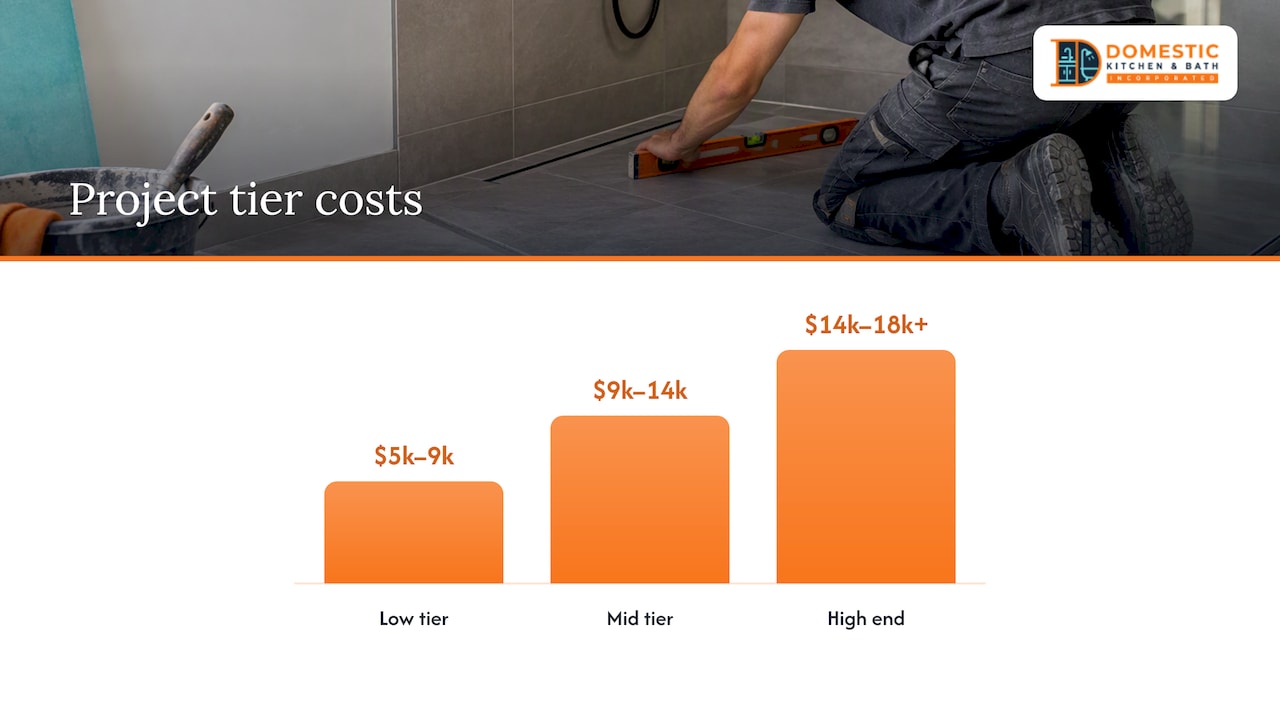
National pricing research backs up this spread. USA Today’s builder-sourced data puts the average walk-in shower install at about $18,000, with small installs as low as $2,000 and large custom projects reaching $30,000. Angi’s cost reporting frames curbless builds specifically as higher-labor projects because the waterproofing area and floor slope work extend well past what a standard shower pan requires.
Why such a wide range? A few factors explain most of the variation:
- Existing floor structure: a slab-on-grade bathroom near the right height costs far less to modify than one needing joist work.
- Drain type: linear drains cost more in substrate and labor than a standard center drain.
- Tile selection: large-format porcelain or natural stone adds setting time and material cost over basic ceramic.
- Regional labor rates: skilled waterproofing and tile labor costs vary by market.
How curbless costs differ from a standard curbed shower
A standard curbed shower and a curbless one use many of the same materials, but a handful of line items account for nearly all the price difference. Breaking these out helps you compare bids on an apples-to-apples basis instead of guessing at a lump sum.
- Floor recessing and slope work: achieving a flush entry means lowering the subfloor or building up the surrounding floor to create a gradual pitch toward the drain, which can add anywhere from a few hundred dollars on a slab that’s already close to level, to several thousand when joists need to be notched or sistered.
- Extended waterproofing: a curbed shower only needs waterproofing inside the pan; a curbless design requires a membrane that extends into the bathroom floor itself, adding labor and material cost proportional to the extra square footage covered.
- Linear drain and substrate: a linear drain system typically costs more than a center drain once you factor in the trough, grate, and the precise substrate work needed to maintain consistent slope in two directions instead of four.
- Tile labor for sloped surfaces: setting tile across a continuous sloped plane that flows from bathroom floor into shower takes more time and skill than tiling a contained shower pan, which shows up as higher labor hours on a bid.
The gap between a curbed and curbless shower narrows considerably when the existing slab is already close to the right elevation and a center drain is acceptable. It widens fast the moment a contractor has to open up a wood-framed floor, reroute plumbing, or extend waterproofing across a larger footprint, which is why two homes with similar-sized bathrooms can see very different curbless price tags.
Primary factors that drive installation cost
Beyond the broad tiers, a handful of site and material choices determine where your project lands within its price band.
- Floor type: a concrete slab is usually the friendlier starting point; a wood-framed floor often needs structural modification to achieve proper slope without compromising joist strength, which can add thousands.
- Drain selection: linear drains offer design flexibility and are popular for accessibility and aesthetics, but they add substrate and labor cost compared with a center drain, as noted in Angi’s curbless shower coverage.
- Waterproofing scope: a full-floor membrane system costs more than localized waterproofing confined to the shower area, but it’s often necessary for a true zero-entry design.
- Tile complexity: large-format tile, mosaic accents, and slip-resistant specialty tile all add setting time and material cost over basic ceramic.
- Plumbing and fixtures: relocating supply lines, adding a bench or niche, or increasing fixture count (rain head, handheld, body sprays) each adds its own labor and material line.
Regional labor rates also matter. Skilled waterproofing and tile setters charge differently depending on local demand and cost of living, so the same scope can price out differently in different markets.
Pro Tip: Ask your contractor to inspect the subfloor and confirm joist direction before finalizing your drain location. This single step prevents the most common and expensive change order on curbless projects.
Timeline, permits, and code considerations
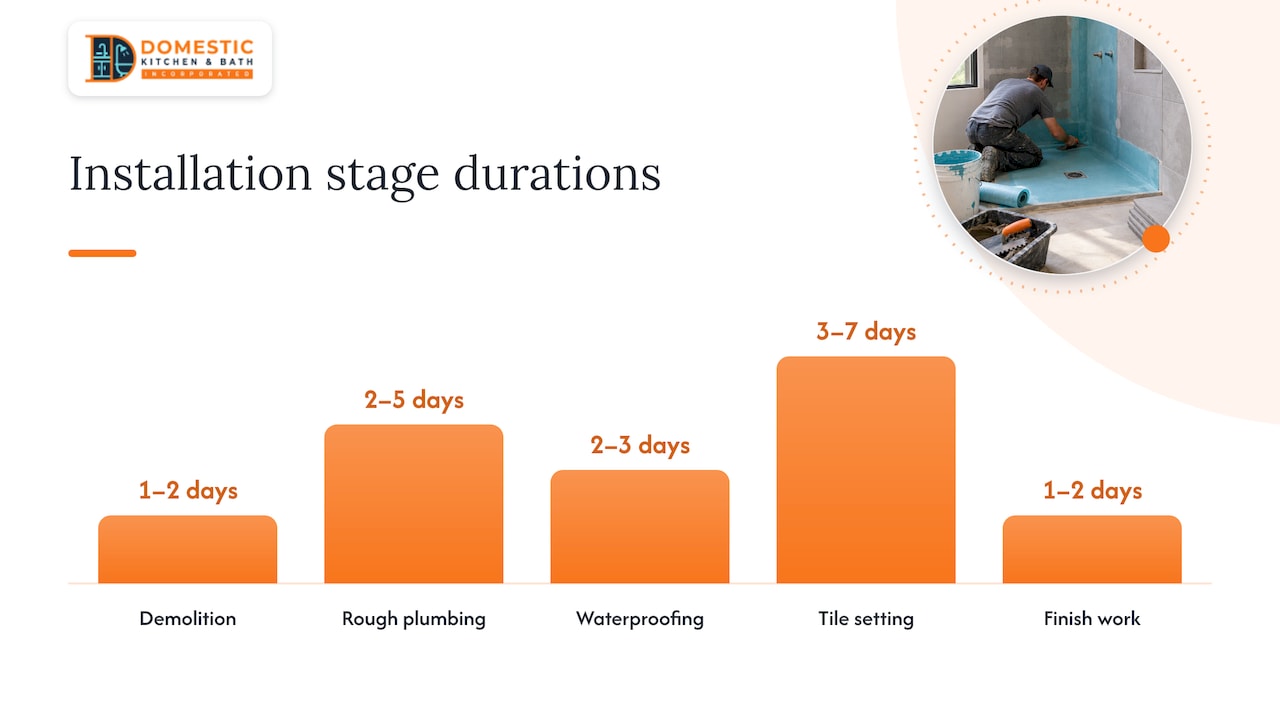
A typical curbless shower install runs two to three weeks once work begins, though full bathroom remodels that include a curbless shower often stretch to four to six weeks.
- Demolition: usually 1 to 2 days to remove the old shower pan, curb, and surrounding flooring.
- Rough plumbing and floor modification: 2 to 5 days, longer if joist work or drain relocation is involved.
- Waterproofing: 2 to 3 days including cure time between membrane coats.
- Tile setting: 3 to 7 days depending on tile size and pattern complexity.
- Finish work: 1 to 2 days for grout, sealant, fixtures, and glass installation.
Most jurisdictions require a permit for any project involving drain relocation or structural floor modification, and inspections typically occur at the rough plumbing stage and again after waterproofing, before tile goes down. Skipping an inspection or scheduling it late is one of the more common reasons projects stall.
Residential plumbing codes also set technical minimums that shape design choices. The 2020 Residential Code of New York State’s plumbing chapter specifies minimum shower dimensions and a minimum shower drain outlet size of 1-1/2 inches, requirements that influence both drain selection and overall layout. Local amendments vary, so confirm the exact requirements with your building department before finalizing your design.
How to get accurate quotes and what to compare on bids
A clear, itemized quote is the single best protection against budget surprises on a curbless project. When you request bids, ask each contractor to break out:
- Demolition and disposal of the existing shower and any affected flooring.
- Subfloor or structural work, including joist modification if your floor requires it.
- Drain type and installation, specifying linear versus center drain and associated substrate cost.
- Waterproofing scope, noting how far the membrane extends beyond the shower footprint.
- Tile and labor, broken out by material cost versus setting labor.
- Grout, sealant, and finish materials.
- Permit fees and inspection scheduling.
| What to compare | Why it matters |
|---|---|
| Itemized vs. lump-sum pricing | Itemized bids let you see exactly where your money goes and compare contractors fairly |
| Warranty terms | Longer warranties on waterproofing and labor reduce your long-term risk |
| Contractor insurance and licensing | Protects you from liability if an accident occurs on-site |
| Experience with curbless specifically | Curbless work demands more precise slope and waterproofing skill than standard showers |
| Contingency recommendation | A contractor who flags unknowns upfront is being realistic, not padding the bid |
USA Today’s reporting suggests budgeting a 10% to 20% contingency for curbless projects, since hidden structural or plumbing conditions are common once demolition starts. Ask directly how many curbless showers a contractor has completed and whether they can speak to subfloor verification as part of their process.
What 25+ years of remodeling has taught us about curbless showers
Over many years and numerous projects, hidden costs have often tripped up homeowners again and again: a subfloor that’s lower than expected, old plumbing that needs rerouting, or a joist layout that doesn’t cooperate with a planned drain location. Our crews verify subfloor depth and drain routing during the initial site visit, before a number ever goes on a quote, which is why our estimates tend to hold up once demolition starts.
Transparent, itemized pricing is the core of how bathroom projects can be scoped. When you know exactly what you’re paying for demolition, waterproofing, drain work, and tile labor, change orders become the exception rather than the rule. Projects backed with satisfaction guarantees help ensure a curbless shower feels like a long-term improvement, not a renovation gamble.
Regional cost factors for curbless showers in Sarasota, Florida
Sarasota’s building conditions bring a few local variables into curbless pricing. Many homes in the area sit on concrete slab foundations, which can work in your favor since slab floors are often easier to modify for a gradual slope than a wood-framed floor requiring joist work. However, older Sarasota homes sometimes have slab elevations that create tight clearances with existing plumbing stacks, which can add cost if drain relocation is necessary.
Florida’s humidity and proximity to the coast also raise the stakes on waterproofing quality. A membrane system that fails prematurely in a high-moisture climate can lead to costly repairs down the road, so local contractors often recommend upgraded waterproofing systems even on mid-range budgets. Permitting and inspection timelines in Sarasota County can also affect your schedule, particularly during peak renovation season when inspectors are booking further out. Confirming local code requirements and permit turnaround times early helps keep a curbless project on track.
Maintenance costs and long-term durability compared with standard showers
A well-built curbless shower generally holds up as well as a standard curbed shower over time, provided the waterproofing was done correctly the first time. The absence of a curb removes one common failure point, the seal where a curb meets the pan, which can crack or degrade over years of use.
The tradeoff is that curbless showers depend more heavily on consistent slope across a larger tiled area to keep water moving toward the drain. If that slope is off even slightly, water can pool near the transition into the bathroom, leading to grout wear or, in worse cases, moisture intrusion into the subfloor. This makes the quality of the initial waterproofing and tile-setting work more consequential for a curbless design than for a standard shower pan, where water is contained in a smaller, more forgiving area. Routine maintenance, resealing grout lines every couple of years and checking silicone seals at transitions, applies to both designs equally.
Is a curbless shower worth the extra cost for most homeowners?
A curbless shower earns its premium for homeowners prioritizing long-term accessibility, a cleaner modern look, or a bathroom they plan to age in place in. It also tends to appeal to buyers if you’re renovating with resale in mind, since open, step-free showers read as updated and functional to a wide range of buyers.
For a budget-limited remodel, though, a curbless shower isn’t always the best use of the first few thousand dollars — you might find it helpful to use the flip or renovate calculator to evaluate your remodeling options. If your floor structure requires extensive joist work to achieve the slope, that money might go further toward cabinetry, countertops, or fixtures elsewhere in the bathroom. Revisit the cost bands above against your actual floor conditions before deciding, since the gap between a modest and a major curbless investment often comes down to what’s already underneath your current shower.
— Mark
Get an itemized curbless shower quote from Domestic Kitchen and Bath
A curbless shower is one of those projects where the quote only means something if it’s itemized, and that’s exactly how we scope every bathroom remodel. Crews inspect the space, check subfloor conditions, and map out drain and waterproofing needs before any estimate is provided.

What you can expect when you reach out:
- A site visit to assess your existing floor structure and plumbing layout.
- An itemized estimate covering demolition, waterproofing, drain selection, and tile labor.
- A clear project timeline built around local climate and permitting requirements.
- A satisfaction guarantee backing the finished work.
If you’re ready to see what a curbless shower looks like for your specific bathroom, visit our bathroom remodeling page to request your itemized quote.
FAQ
How much does it cost to install a curbless shower?
Most curbless shower installs cost between $5,000 and $18,000, with the national average for a professionally installed walk-in shower around $18,000. Your final cost depends heavily on floor type, drain selection, and how much waterproofing the project requires.
Is a curbless shower more expensive?
Yes, a curbless shower typically costs $500 to $7,000 more than a standard curbed shower. The added cost comes mainly from floor recessing, extended waterproofing, and the slope work needed for a flush entry.
Is a curbless shower a good idea?
A curbless shower works well for homeowners who want long-term accessibility, a modern look, or a bathroom designed to age in place in. It carries a higher upfront cost than a standard shower, so it makes the most sense when those benefits align with your goals for the space.
Is $10,000 enough for a bathroom remodel?
A budget within the low to mid-range tier can cover a curbless shower on its own, but it likely won’t stretch to a full bathroom remodel that also includes new cabinetry, countertops, or extensive tile work. For a complete bathroom renovation, our bathroom remodeling services typically range from 15000 to 45000 dollars depending on scope.
Sources
- What Is A Curbless Shower? | Angi
- Walk-in shower cost and ROI explained by builders | USA Today
- CHAPTER 27 PLUMBING FIXTURES – 2020 RESIDENTIAL CODE OF NEW YORK STATE