
Shaker cabinets have a five-piece door with a recessed center panel. Slab cabinets (also called flat-panel) have one flat piece and no frame. Choose shaker if you want a classic look that suits almost any home and hides everyday wear. Choose slab if you want a clean, modern kitchen that wipes down in one pass. In a humid place like Sarasota, the quality of the construction and the finish matters more than the door style.
This guide walks through the real differences, what each style costs you in upkeep, how each behaves in Florida’s climate, and how to decide without regretting it in five years.
TL;DR
- Look: Shaker is the versatile, traditional-leaning default. Slab is minimal, modern and architectural.
- Cleaning: Slab wipes clean fast. Shaker’s recessed corners and bottom ledge collect dust and grease.
- Wear: Shaker hides fingerprints and small nicks better. Slab shows them on its broad flat surface.
- Florida factor: Painted shaker can develop hairline joint cracks as wood moves with humidity. Slab can fail at the edges if they are not sealed well. Core material and edge quality decide the outcome.
- Cost: Door shape alone does not set the price. Finish, materials and box construction do.
Table of Contents
- What actually separates the two styles
- Which style fits which kitchen
- Cleaning and daily wear
- What humidity does to each style in Florida
- Cost: what really changes the price
- Installation: why slab demands precision
- The hybrid option: shaker and slab together
- How to decide: five questions
- Our view: pick the build before the profile
- Ready to see it in your own kitchen?
- FAQ
- Sources
What actually separates the two styles
The difference starts with construction. A shaker door is built from five pieces: two vertical stiles, two horizontal rails and a flat panel set into the frame. A slab door is a single flat piece with no frame, no groove and no recess.
That structural difference drives everything else:
- Visual depth. Shaker’s frame casts small shadow lines. Slab reads as one calm plane.
- Cleaning. More edges and corners mean more places for grime.
- Movement. Joints between pieces can shift slightly over time. A one-piece door has no joints.
- Installation tolerance. Face-frame shaker boxes are more forgiving than frameless slab boxes (more on that below).
Slab doors are also often paired with frameless, European-style cabinet boxes, while shaker is commonly built face-frame. That pairing, not the door itself, explains many of the cost and installation differences people attribute to the style.
Which style fits which kitchen
When shaker is the better fit
Shaker works in traditional, transitional, farmhouse, coastal and many contemporary kitchens. If your home has crown molding, paneled doors or older architectural details, shaker echoes them. It is also the safer choice when you think about resale, because the broad buyer pool is comfortable with it.
The National Kitchen & Bath Association’s KBIS 2026 kitchen trends report points the same way: shaker is the timeless standard, and it suits homeowners who want broad appeal or live in a home with traditional architecture.
When slab is the better fit
Slab suits kitchens that aim to feel curated and minimal: integrated appliances, simple hardware or push-to-open doors, full-height backsplashes and bold stone. NKBA’s 2024 kitchen trends listed slab door style among the contemporary, clean-line choices, and its review of 2025 trends described flat-panel cabinetry, panel-ready appliances and slab backsplashes as delivering a clean look without losing warmth.
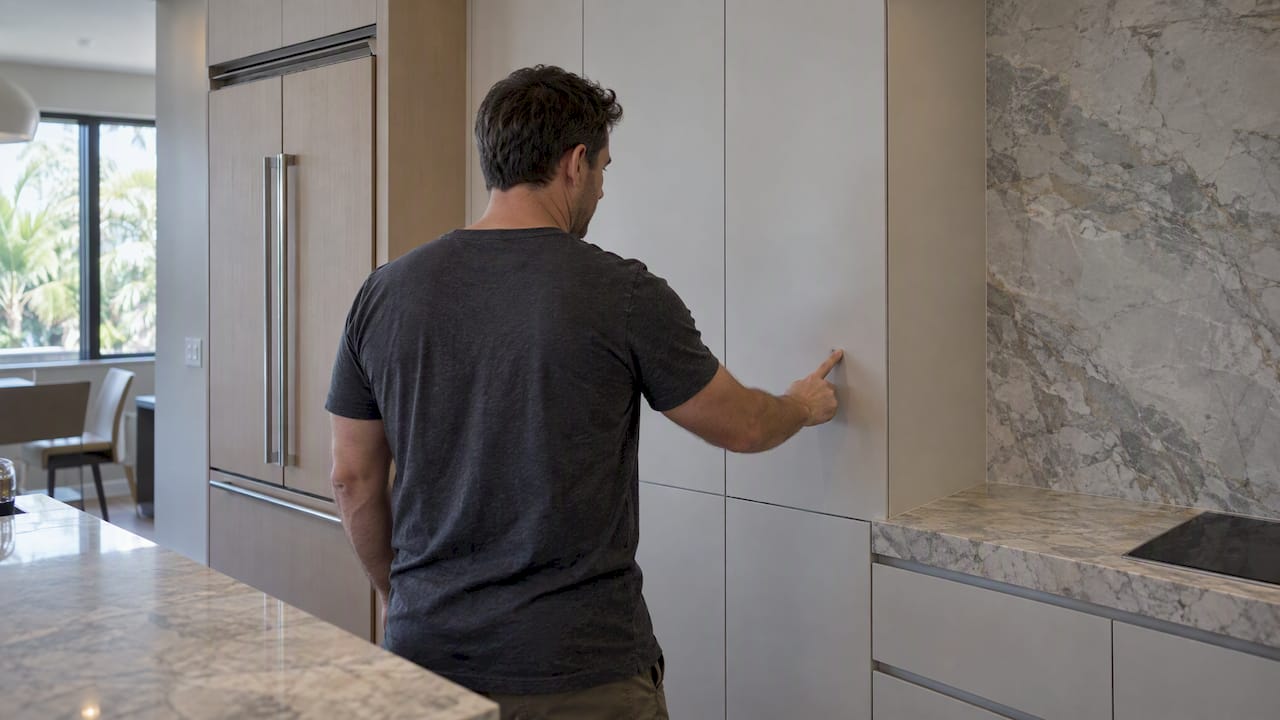
If you worry that flat-panel is dated, the current direction says otherwise. Houzz’s design team has described slab fronts in matte, wood-grain or soft neutral finishes as sought after by homeowners who want a kitchen that lasts and avoids over-decoration.
A quick comparison
| Factor | Shaker | Slab (flat-panel) |
|---|---|---|
| Door construction | Five pieces, recessed center | One flat piece |
| Overall look | Classic, versatile, softly traditional | Minimal, modern, architectural |
| Daily cleaning | More detail work in corners and on the lower ledge | One-pass wipe |
| Hides fingerprints and nicks | Better | Less well |
| Humidity risk | Hairline cracks at joints on painted finishes | Edge-banding or moisture issues if edges are poorly sealed |
| Installation | More forgiving with face-frame boxes | Less forgiving, needs precision |
| Resale appeal | Broad | Strong in modern and transitional homes |
Cleaning and daily wear
If you cook often, this is where the styles diverge most in real life.
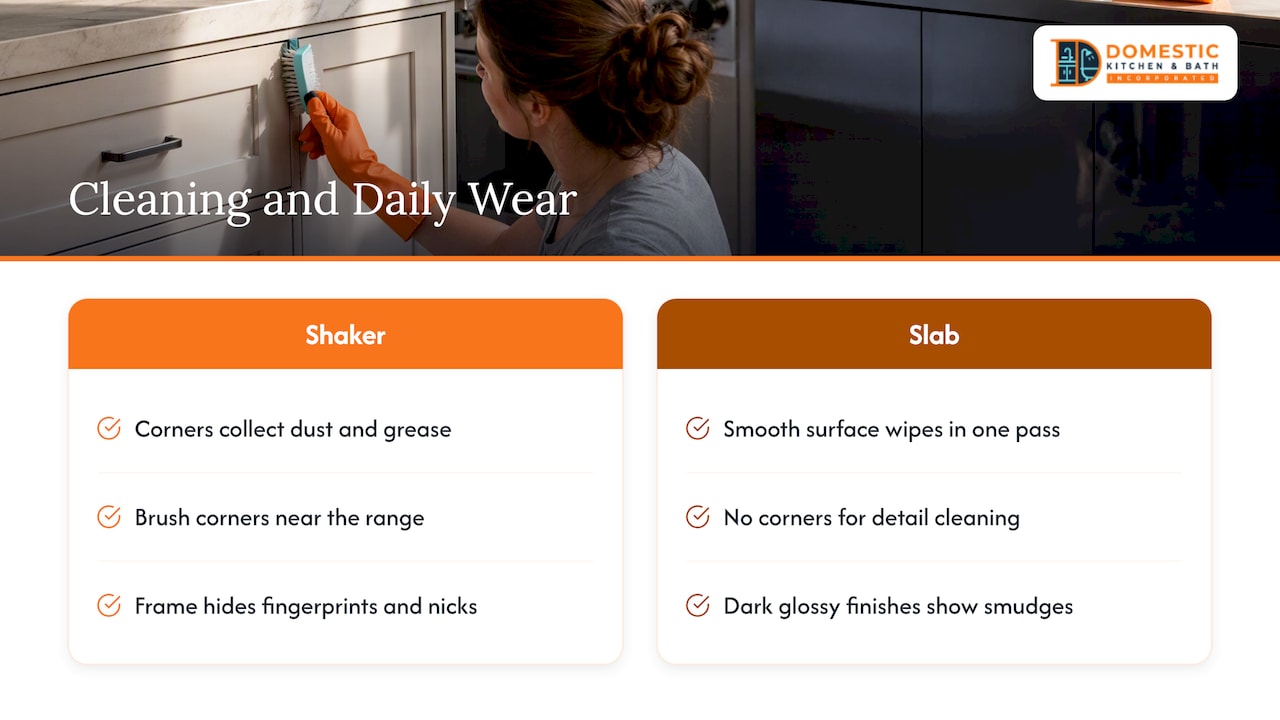
Slab doors have a flat, smooth surface that you can wipe in a single pass. Shaker doors have inside corners and a small ledge along the bottom rail, and dust and cooking grease settle there. Near the range, expect to use a soft brush or cloth in the corners now and then.
Wear is the reverse. The detail of a shaker frame breaks up the surface, so a fingerprint or a small nick is less visible. On a broad slab door in a dark or glossy finish, every smudge shows. If you have young kids, a high-gloss slab in black or deep navy will keep you wiping all day. A matte or wood-grain slab is far more forgiving.
A practical rule: pick slab if you prefer a quick wipe-down over occasional detail cleaning, and shaker if you would rather not see every touch mark.
What humidity does to each style in Florida
This is the part generic cabinet guides skip, and it matters here. Wood expands and contracts with moisture. The Woodwork Institute’s guidance on controlling relative humidity reminds owners that uncontrolled humidity causes dimensional problems in architectural woodwork, because wood and wood-based products move naturally.
Here is how that plays out:
- Painted shaker. The joints between stiles, rails and panel can show hairline cracks in the paint as the wood moves through humid and dry seasons. Good manufacturing reduces it, but treat it as a cosmetic trait of wood-frame construction, not automatically a defect.
- Slab. No joints, so no joint cracks. The weak point is the edge. If edge-banding is thin or the edges are not factory-sealed well, moisture can get in and the door can lift or swell.
So neither style is the clear winner for coastal Florida. The better question is: how is this specific door built? Ask about the core material (MDF versus plywood or solid wood), the quality of the edge-banding or sealing, the finish, and whether the manufacturer’s warranty addresses humidity and environmental stability. Expert installers consistently say that material quality matters more than door style, and a warranty that speaks to environmental stability is a good sign of how a maker sees its own product.
Practical steps for any Sarasota kitchen:
- Keep the air conditioning running and consider a dehumidifier if the house sits empty part of the year.
- Use the range hood every time you cook, and make sure it vents outside.
- Wipe up water near the sink and dishwasher promptly, especially along bottom edges.
- Ask for sealed edges on cabinet boxes and doors near water.
Cost: what really changes the price
It seems logical that a one-piece slab door should cost less than a five-piece shaker door, and it is often cheaper to manufacture. But the retail gap is frequently small, and sometimes reversed. Slab designs are often built with premium finishes, such as matte lacquer, veneer or textured laminate, and frameless boxes, and those raise the price.
When you compare quotes, compare the same things:
- The door material and finish (painted, stained, laminate, veneer)
- Box construction and thickness
- Hinge and drawer hardware quality
- Whether the quote includes installation, trim, filler panels and finishing
A basic painted shaker and a high-end veneer slab can be priced very differently, and the door shape is only part of the reason. At our firm, cabinets are one line in a larger project: demolition, plumbing, electrical, countertops, flooring, lighting and appliance installation all sit alongside them. Our published range for a full kitchen remodel is $25,000 to $45,000, and your door choice moves the total less than layout changes, countertop material and appliance packages do.
Installation: why slab demands precision
Flat doors have no frame to hide imperfections. Reveals (the gaps between doors) are obvious, because the eye reads straight lines across a plain surface. If a gap tapers by a few millimeters, you will see it.
Face-frame shaker cabinets give installers a little room to work with when walls are not perfectly flat or plumb. Frameless slab cabinets are less forgiving. Many Florida homes, especially older ones, have walls and floors that are not perfectly level, so shimming, scribing and careful leveling matter. This is where an experienced project manager earns their fee, and it is a good reason to hire a contractor who installs cabinetry every week rather than treating it as a side task.
The hybrid option: shaker and slab together
You do not have to pick one. Many designers combine shaker on the perimeter with slab on the island, or the reverse. Done on purpose, it adds interest. NKBA’s 2026 trends report is the source for the idea that this works best when the finishes are cohesive.
To keep it from looking indecisive:
- Use the same color family, such as soft white shaker with a matching white slab.
- Or carry one wood tone, like a warm white oak stain, across both door types.
- Keep hardware consistent in finish.
- Use slab in one clear zone (island, tall pantry wall) rather than scattering it.
How to decide: five questions
- What does your home’s architecture say? Traditional details point to shaker. Clean modern lines point to slab.
- Do you want a quick wipe or camouflage? Slab cleans faster. Shaker hides marks.
- Who will buy this house, and when? If you may sell within a few years, shaker has the broadest appeal.
- What is your countertop? Bold stone movement tends to look striking against plain slab fronts, while shaker balances quieter quartz or classic granite.
- How is the cabinet built? Core material, edge sealing, finish and warranty outweigh the door profile.
Our view: pick the build before the profile
We have remodeled kitchens in Sarasota for more than 25 years, and the question we hear most is which door style is “better.” Our honest answer is that it is the wrong first question.
A well-built shaker door and a well-built slab door can both last in this climate. A poorly sealed version of either will disappoint you. So we start with how you cook, how you live and what the room looks like, then talk about construction, finish and warranty protection suited to Florida, and only then settle the door.
We also tell clients plainly about trade-offs. If you love a dark, glossy slab but have three kids and a dog, we will say you will be wiping it daily. If you love white painted shaker, we will say that hairline joint lines can appear over the years and that this is normal for wood. We would rather you hear it from us before the contract than discover it after.
Three things we recommend on nearly every project: plan the layout in 3D before ordering anything, so you can see door style against your countertop and flooring; confirm what is included in the price in writing; and have permitting handled by the people doing the work, since electrical and plumbing changes behind cabinets often require it.
— Mark
Ready to see it in your own kitchen?
If you are planning a full remodel in Sarasota or the surrounding area, we design custom kitchens with 3D planning and manage the whole project, from demolition to appliance installation. You can see how we work on our kitchen remodel page for Sarasota or check the current kitchen remodel offer. Our published range for kitchen remodeling is $25,000 to $45,000, and we come to you to talk through door styles with your actual space in mind. Start at Domestic Kitchen & Bath.
FAQ
What are the downsides of shaker cabinets?
The recessed corners and bottom ledge collect dust and grease, so they take more detailed cleaning. On painted finishes, hairline cracks can appear at the joints as the wood moves with humidity. Shaker is also less distinctive, since it is the most common style, which some people count as a plus and others as a drawback.
What are the cons of slab kitchen cabinets?
Fingerprints, smudges and small nicks show more on a broad flat surface, especially in dark or glossy finishes. Slab leaves little room for installation error, so gaps and misalignment are obvious. Poorly sealed edges can let moisture in, which matters in Florida.
Are slab cabinets in style?
Yes. NKBA’s trend reporting includes flat-panel cabinetry among the looks of recent years, and Houzz’s design experts say the idea that flat-panel is dated is outdated. Matte, wood-grain and soft neutral slab finishes are the most current versions.
Is shaker or slab better for resale?
Shaker has the broadest appeal and fits the widest range of homes, so it is the lower-risk choice if you may sell soon. Slab can add value in a modern or transitional home where the rest of the design matches. Quality of construction and finish counts either way.
Sources
- NKBA | KBIS 2026 Kitchen Trends Report
- NKBA 2024 Kitchen Trends
- NKBA: Year in Review, Top Kitchen & Bath Trends of 2025
- Houzz Pro: 2026 home design predictions
- Woodwork Institute: care and storage, relative humidity guidance