
Porcelain slab countertops are large, thin sheets of fired porcelain, cut and fitted like stone, that give you a nearly seamless surface that resists heat, stains and sun. Installed, they typically run in the same range as mid-priced quartz, and they are the best choice for some kitchens and a poor one for others. This guide covers what they are, what they cost, where they beat quartz, where they don’t, and what to settle before you sign a contract.
TL;DR
- Porcelain slabs are large-format sheets, commonly 6 mm, 12 mm or 20 mm thick, that can run up to about 5 by 10 feet, so one piece can cover a whole island with no grout lines.
- Expect roughly $55 to $120 per square foot installed nationally. Most of that is fabrication and labor, not the slab itself.
- Porcelain beats quartz on heat and UV resistance and needs no sealing. Quartz is slightly tougher against impact, and porcelain can chip or crack if a heavy pot lands on an edge.
- It is a strong fit for Florida outdoor kitchens, but it is not a DIY material. Choose a fabricator who handles cutting, edges and support properly.
Table of Contents
- What porcelain slab countertops actually are
- Pros of porcelain kitchen counters
- Cons you should hear before you buy
- Thickness: 6 mm, 12 mm or 20 mm
- Porcelain slab vs. quartz
- What porcelain slab countertops cost
- Porcelain for outdoor kitchens
- Our perspective
- How to choose a porcelain countertop wisely
- Care and repair
- Is porcelain right for your remodel?
- FAQ
- Sources
What porcelain slab countertops actually are
A porcelain slab is a large porcelain tile. Fine Homebuilding describes slabs available in sizes up to 10 by 5 feet, which replace a grid of grout lines with one continuous surface. That is the whole appeal: a counter, a backsplash and even a shower wall can come from the same material, with very few joints to clean.
Porcelain is a type of ceramic, but not all ceramic is porcelain. ANSI A137.1:2022 defines porcelain tile as ceramic tile with water absorption of 0.5% or less. HGTV explains that higher-grade clays and higher firing temperatures make porcelain harder, denser and less porous than ordinary ceramic, which is softer, easier to cut and more prone to absorbing moisture and staining. So the wall tile in a budget bathroom is not the same product as a countertop slab.
You will also see the terms “gauged porcelain panels” and “large-format porcelain.” For countertop purposes they mean the same family of products. MSI, for example, lists U.S.-market slabs at nominal sizes around 62 to 63 by 126 inches in 6 mm, 12 mm and 20 mm thicknesses, intended for countertops, waterfall islands, backsplashes, shower walls, fireplaces, floors and outdoor use.
Pros of porcelain kitchen counters
Heat, stains and sun
Porcelain is fired at very high temperatures before it ever reaches your kitchen, so a hot pan is far less of a worry than on quartz, where resin binders can scorch. Real Simple notes porcelain is more heat-resistant than quartz and roughly on par with it for stain resistance, maintenance and appearance. It is also UV-stable, so it does not fade or discolor in sunlight, which matters in Florida.
No sealing
Porcelain is non-porous. Per the same source, you clean it with soap and water or a soft cleanser, and you never reseal it. Compare that with natural stones like granite or marble, which generally need periodic sealing.
Seamless looks
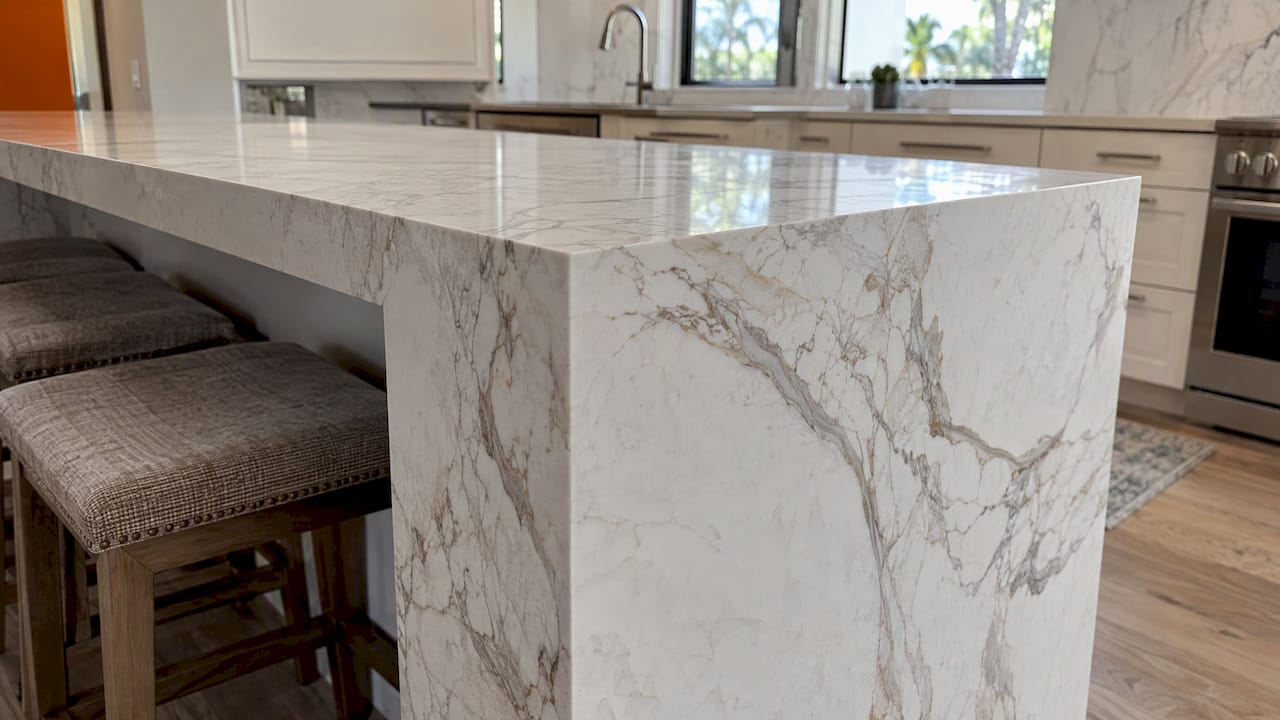
Because slabs are so large, you can get a waterfall island or a wrapped backsplash with few visible seams. Stone World reports that specialists value large-format porcelain because the same coordinated material can run across counters, floors, walls, vanities and showers with far fewer grout joints. For a family that hates scrubbing grout, that is a practical gain, not just a style choice.
Thin, lighter material
Thinner slabs weigh less than thick stone, which can simplify some installations and allows slimmer edge profiles. Thickness has trade-offs, covered below.
Cons you should hear before you buy
Brittleness
Porcelain is hard, but hard is not the same as tough. Fine Homebuilding says porcelain countertops are brittle and can crack under blunt force or when heavy items are dropped. In testing of a sintered surface, Consumer Reports found that Dekton resisted heat and stains but cracked in an impact test simulating a heavy object falling from two feet. That test covered one product, but it is a fair reminder: treat a porcelain edge over the dishwasher or beside the range with respect.
Chips are hard to hide and hard to fix
Printed-surface porcelain carries its color and pattern on the face only. If it chips, the body underneath shows a different color. Through-body porcelain carries color through the slab, so, as the International Surface Fabricators Association points out, incidental chips are less conspicuous. If you have kids, a busy sink area or a heavy cast-iron habit, ask specifically whether the slab you like is through-body.
Fabrication is specialized
Slabs are thin and rigid, so they are delicate to carry and difficult to cut without specialized tools. Fine Homebuilding does not recommend porcelain slab installation for DIYers. In practice that means the quality of your countertop depends heavily on the shop that templates, cuts and sets it, and on the cabinet base underneath.
Limited edge and pattern choices
Thin slabs are often mitered to create a thicker-looking edge, and sharp, crisp profiles are the norm. Highly ornate edges are harder to achieve than in granite. If you want a deep ogee, quartz or natural stone may suit you better.
Thickness: 6 mm, 12 mm or 20 mm
Thickness drives both price and how the counter is built.
| Thickness | Typical use | What to know |
|---|---|---|
| 6 mm | Walls, backsplashes, shower surrounds, laminated builds | Too thin to span cabinets on its own |
| 12 mm (about 1/2 inch) | Countertops with a supporting substrate, islands, outdoor kitchens | Common for counters; edges are often mitered for a thicker look |
| 20 mm (about 3/4 inch) | Countertops, including outdoor and overhang areas | Sturdier, can often sit on cabinetry with less support |
Fine Homebuilding identifies common countertop thicknesses of 12 mm, 2 cm and 3 cm, and notes that thinner slabs are commonly wrapped around a supporting substrate, while thicker slabs can overhang cabinetry directly. Ask your fabricator which method they use, how the seams are placed and how far an overhang can extend without support. Seating overhangs are where thin slabs most often fail.
Porcelain slab vs. quartz
This is the comparison most homeowners actually make. Real Simple sums it up: porcelain has better heat resistance, quartz is slightly more durable, and the two are roughly equal on stain resistance, maintenance and appearance. Porcelain is generally less expensive than quartz.
| Factor | Porcelain slab | Quartz |
|---|---|---|
| Heat | Very resistant | Resin can be damaged by hot pans |
| Impact | More brittle at edges and corners | Slightly more durable |
| Stains | Non-porous, very resistant | Very resistant |
| Sealing | Never | Never |
| Sunlight | UV-stable, good outdoors | Can discolor outdoors over time |
| Edge profiles | Mostly clean, mitered edges | Wide range |
| Fabrication | Specialized, less forgiving | Widely handled by most shops |
A simple rule: if you cook hard, entertain outside or want a seamless, low-maintenance look, lean porcelain. If you want the most forgiving surface for a rough-and-tumble household, or an elaborate edge, lean quartz. Neither is a wrong answer in a well-built kitchen.
What porcelain slab countertops cost
National figures from Fixr put gauged porcelain slab countertops at roughly $55 to $120 per square foot installed, covering the slab, fabrication, edging, a sink cutout and installation. Its national project range is $1,750 to $3,600, and a typical 30-square-foot project lands around $2,500. Those are national averages, and Florida projects with islands, waterfalls or complex layouts can sit outside them.
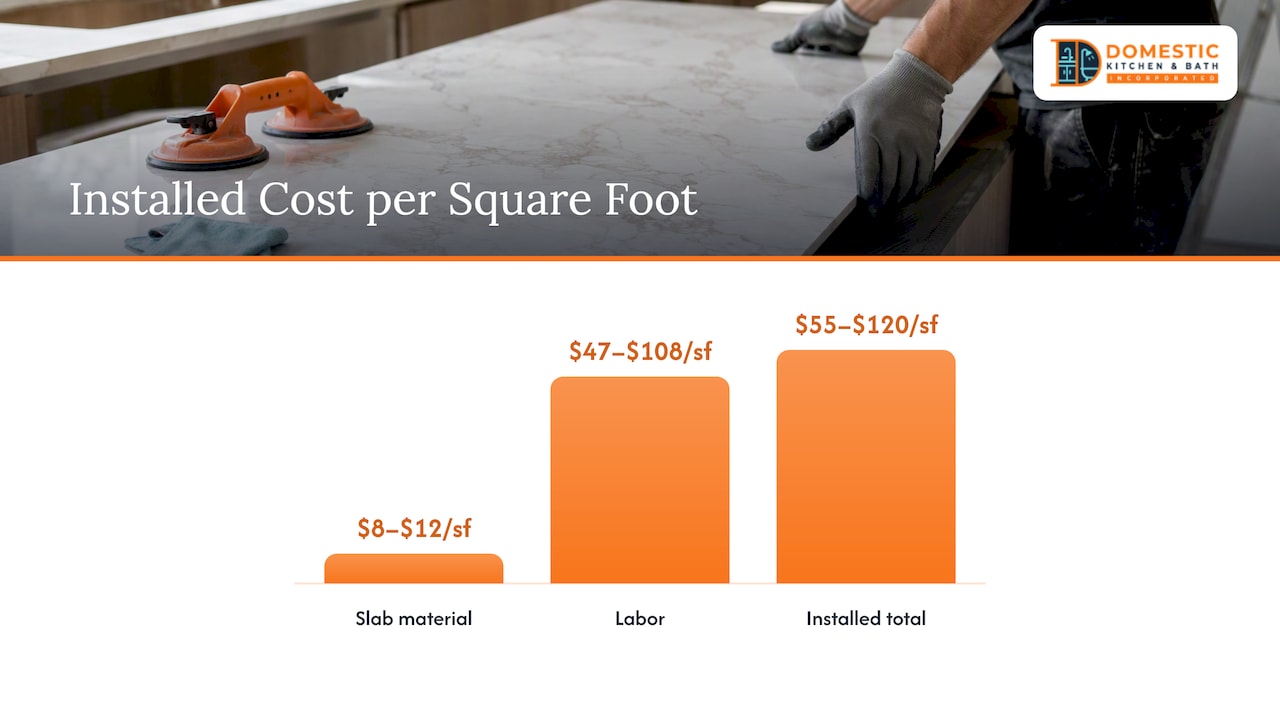
The breakdown is the surprising part. Fixr lists the porcelain slab material at only about $8 to $12 per square foot, while fabrication and installation labor runs about $47 to $108 per square foot, because cutting, transport and fitting are technically demanding. When a quote looks high, the labor and handling are usually why, not the slab.
What moves your price:
- Layout: an island with a waterfall edge needs more slab, more mitered cuts and more labor than a straight run.
- Cutouts: undermount sinks, cooktops and faucet holes each add careful machining.
- Edges: mitered edges cost more than a plain edge.
- Slab choice: through-body and premium patterns cost more than printed surfaces.
- Support and demolition: old countertops, cabinet repairs and plumbing changes sit outside the countertop line item.
Countertops inside a full remodel
Countertops are one line in a larger budget. Our published project ranges are $25,000 to $45,000 for kitchen remodeling, $15,000 to $45,000 for bathroom remodeling and $20,000 to $50,000 for outdoor kitchens. Choosing porcelain rather than quartz is rarely what tips a project from one end of those ranges to the other. Layout, cabinetry, appliances and the scope of plumbing and electrical work matter far more.
Porcelain for outdoor kitchens
Sun is where porcelain pulls ahead. Real Simple notes that its UV stability prevents fading and discoloration, which makes it a suitable choice for outdoor kitchens. Add heat tolerance near a grill and non-porous stain resistance for spills, and it fits Sarasota patios well.
A few things to plan for:
- Base structure: outdoor cabinetry and masonry bases need to be flat and rigid, since a thin slab can crack over an uneven surface.
- Expansion and drainage: outdoor installations should account for heat, rain and drainage, which your contractor should explain before building.
- Shade and comfort: if your cooking area sits on a lanai or under a covered patio, window treatments such as PVC plantation shutters can help manage glare and heat around the space.
For more on materials, see our guide to outdoor kitchen countertops for Sarasota homeowners, and our checklist on outdoor kitchen plumbing prep.
Our perspective
We have been remodeling kitchens and baths in Sarasota for over 25 years, and we are a family-owned business. Here is how we think about porcelain.
First, the slab is only half the decision. The counter is as good as the template, the cut, the support underneath and the way it is set. A beautiful slab on a poorly leveled cabinet run is a future crack. That is why we plan layouts in 3D before demolition and walk you through where seams, cutouts and overhangs will fall.
Second, match the material to the household. A couple who wants a spa-like bathroom vanity and a clean shower wall will love the seamless look. A family with young children and a heavy cookware habit might be happier with quartz at the island and porcelain elsewhere. We would rather tell you that now than after installation.
Third, pricing should be transparent. We want you to see what goes into the counter, the cabinetry, the plumbing and the permits, so there is no sticker shock midway through the project. And Florida is its own climate: heat, humidity and local permitting shape what we recommend, especially outdoors.
— Mark
How to choose a porcelain countertop wisely
- Decide indoors, outdoors or both. Outdoor kitchens benefit most from UV stability. Use the same family of material indoors and out if you want a continuous look.
- Ask if the slab is through-body or printed-surface. Chips are much less noticeable on through-body material and hard to repair on printed surfaces.
- Pick the thickness with your fabricator. Ask how the counter will be supported and what overhang is safe.
- See the slab in person. Patterns on large slabs vary, and a small sample cannot show you the veining across a whole island.
- Plan the seams. A good layout puts seams where they are least visible and best supported.
- Have the whole job under one plan. Plumbing, electrical, cabinetry and countertops need to be sequenced together. Mismatched trades are the most common cause of delays.
Care and repair
Daily care is simple. Real Simple says porcelain does not need sealing and can be cleaned with soap and water or a soft cleanser such as Bar Keepers Friend. Skip abrasive pads and harsh scouring on polished finishes, and use a cutting board anyway to protect your knives.
Protect the edges. Do not use the counter edge as a leverage point or set heavy cookware down hard near the sink and range. If a chip happens, tell your fabricator early. Repairs are difficult, particularly on printed-surface slabs, and a professional can advise whether the damage can be filled or the section needs replacing.
Is porcelain right for your remodel?
It is a good choice if you want a clean, modern, low-maintenance surface, you cook with high heat or you are building an outdoor kitchen under the Florida sun. It is a weaker choice if you want ornate edges, if impact is a daily risk, or if your budget leaves no room for a skilled fabricator.
If you are planning a kitchen, bath or outdoor kitchen in Sarasota and want to see porcelain next to quartz in your own layout, we design, permit and build the whole project for you. Start with our kitchen, bathroom and outdoor kitchen remodeling page, or see our outdoor kitchen contractors in Sarasota if the patio is your priority. Our work comes with a satisfaction guarantee, and we have completed more than 1,000 projects.
FAQ
Is porcelain or quartz more expensive for countertops?
Porcelain is generally less expensive than quartz, according to Real Simple. Installed porcelain slab prices still vary widely because fabrication is a large share of the cost. Compare written quotes for your actual layout rather than national averages.
What is the difference between porcelain and ceramic?
Porcelain is a type of ceramic made from higher-grade clays and fired hotter, which makes it denser and less porous. Under the ANSI A137.1 standard, porcelain tile absorbs 0.5% water or less. Ordinary ceramic is softer and absorbs more moisture.
Can I install a porcelain slab countertop myself?
We don’t recommend it. Fine Homebuilding advises against DIY installation because slabs are thin, rigid and difficult to cut without specialized tools. A cracked slab costs far more than a professional install.
Do porcelain countertops stain or need sealing?
Porcelain is non-porous, so it resists stains and never needs sealing. Soap and water or a soft cleanser is enough for regular cleaning. The main risk is chipping, not staining.
Sources
- Guide to Countertops: Porcelain, Fine Homebuilding
- Are Porcelain Countertops Worth It?, Real Simple
- Porcelain Countertops Cost, Fixr
- Best Countertops for Your Bathroom Vanity, Consumer Reports
- Tile Countertops, International Surface Fabricators Association
- Stile Porcelain Slabs, MSI Surfaces
- Gauged Porcelain Tile Panels/Slabs Trends, Stone World
- Ceramic vs. Porcelain Tile, HGTV
- The Eminence of Porcelain Tile, ANSI Blog