
A countertop edge profile is the shape cut into the outer edge of your counter. The most common choices are eased, straight, bevel, bullnose, ogee, mitered and waterfall. Most homeowners are happiest with an eased edge for a clean, modern, easy-to-wipe kitchen, a bullnose or half bullnose for a softer, traditional look, and a mitered or waterfall edge when they want the counter to look thick and dramatic.
The edge costs little compared with the slab, yet you touch it every day. It affects how the kitchen looks, how easily you clean it, and how a chip or a bump to the hip feels. This guide walks through each profile, compares the practical differences, explains mitered versus eased edges, and gives you a simple way to decide.
TL;DR
- Eased and straight edges are the simple, modern, easy-to-clean defaults. Bevel adds a subtle angled line.
- Bullnose is softer and family-friendly, but it suits traditional cabinetry best and makes crumbs harder to sweep off the edge.
- Ogee and other ornate profiles look formal, but their grooves collect debris and their thin details are more exposed to chips.
- A mitered edge joins two pieces at 45 degrees to make a slab look thick. It takes more labor, so expect a higher price than an eased edge.
- Availability depends on the material and thickness, so confirm the profile with your fabricator before you fall in love with it.
Table of Contents
- What an edge profile is and why it matters
- The main countertop edge styles
- Quick comparison of edge profiles
- Practical differences: cleaning, durability and safety
- Mitered edge vs. eased edge
- Is a bullnose edge outdated?
- What profiles are available for quartz?
- How much do edge profiles cost?
- How to choose your edge: a simple method
- Our perspective: what we tell Sarasota homeowners
- Planning a kitchen remodel? Start with the whole picture
- FAQ
- Sources
What an edge profile is and why it matters
Every countertop has a top surface, a front edge and an underside. The profile is the shape of that front edge, from a sharp right angle to a deep, curved S. Fabricators cut it into the slab with a router and polishing tools, so it is part of the fabrication, not an add-on you buy separately.
Cambria says edge choice is primarily a matter of aesthetics, though thickness affects which profiles are possible. In daily life, three things matter:
- Look. The edge sets the tone of the kitchen. A crisp edge reads contemporary. A curved or carved edge reads traditional.
- Cleaning. Smooth, simple edges wipe clean in one pass. Grooves hold grease and crumbs.
- Durability and safety. Corners that are rounded off resist chipping and are kinder to children and to anyone walking past in a hurry.
The main countertop edge styles
Here are the profiles you will see on almost every fabricator’s sample board, described the way the manufacturers describe them.
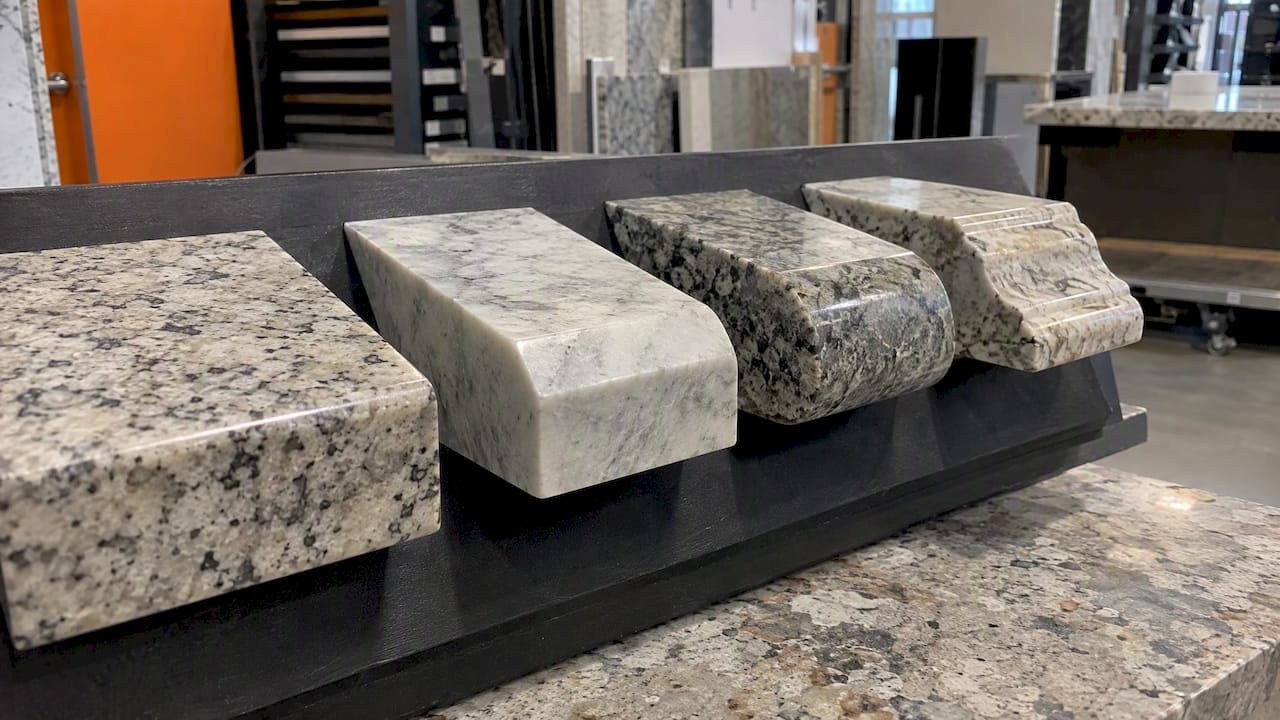
Eased edge
An eased edge is a straight, square line with slightly softened corners. Cambria and Caesarstone both describe it as a softened square. It is the profile most people end up choosing because it disappears into the design. It works with flat-panel and Shaker cabinets alike, and it looks right in a transitional kitchen, which is what many Florida homes call for.
Straight (square) edge
A straight edge is a clean right angle. It gives the sharpest, most architectural line and suits minimalist kitchens. The trade-off is that a true square corner is more exposed to knocks, which is why many fabricators ease it slightly even when you ask for “square.”
Beveled edge
A bevel is a diagonal cut along the top edge, typically 45 degrees. It catches light and adds a thin shadow line without going ornate. Caesarstone notes that the size of the cut changes the character: its 1/8-inch profile reads rounder than its 1/2-inch bevel. A small bevel is a good middle path between eased and bullnose.
Bullnose and half bullnose
A full bullnose is a smooth curve rounded over both the top and the bottom of the edge. A half bullnose rounds the top and flattens underneath, as Caesarstone describes it. Both feel soft in the hand and are less prone to damage, but Southern Living points out that the curve makes it harder to sweep crumbs off the counter into your palm.
Ogee
An ogee is an S-shaped profile that combines a concave and a convex curve. It is the formal, furniture-like choice for traditional and classic kitchens, often with natural stone. It needs more cleaning attention because the curve and the groove catch debris, and it is the profile most likely to look out of place in a modern room.
Mitered edge
A mitered edge joins two pieces of stone at a 45-degree angle so the front looks much thicker than the slab really is. We cover it in detail below.
Waterfall edge
A waterfall continues the countertop material down the side of an island or peninsula to the floor. It is a statement piece, usually built with mitered corners, and it works best on a single island where you want a sculptural look.
Chiseled edge
A chiseled edge is hand-textured or rough-cut to look rustic, like quarried stone. It suits farmhouse and Old World designs and is rarely a fit for a sleek kitchen.
Quick comparison of edge profiles
| Profile | Look | Cleaning | Chip resistance | Best with |
|---|---|---|---|---|
| Eased | Clean, soft square | Very easy | Good | Almost any style |
| Straight | Sharp, minimal | Very easy | Lower, corner exposed | Modern, minimalist |
| Bevel | Crisp with a light line | Easy to moderate | Moderate | Transitional, modern |
| Half bullnose | Soft, classic | Moderate | Good | Traditional, family kitchens |
| Full bullnose | Rounded, traditional | Moderate | Very good | Traditional, family kitchens |
| Ogee | Ornate, formal | Harder, grooves trap debris | More exposed detail | Traditional, formal |
| Mitered | Thick, substantial | Easy | Sharp corners need care | Modern, statement islands |
| Waterfall | Dramatic, continuous | Easy | Sharp corners need care | Modern islands and bars |
The ratings reflect the general guidance from the sources in this article. Your specific stone or quartz, its thickness and the fabricator’s workmanship all change the result.
Practical differences: cleaning, durability and safety
Cleaning
Simple, ungrooved edges such as eased and square profiles wipe clean in a single pass, while an ogee can trap crumbs, grease and debris in its curves. If you cook daily and have a busy kitchen, that matters more than it sounds. A bullnose is easy to wipe but, as noted above, not as easy to sweep.
Durability
The general principle is that more material at the edge spreads out an impact. Broad rounded profiles tend to resist chips better than thin lips or sharp points, and a generous ease, a pencil round or a full bullnose are the safe choices for hard use. Thin ogee details and sharp miter corners are the more vulnerable geometries. This is a fabrication principle, not a guarantee: a well-made miter can last for decades, and a poorly finished bullnose can still chip.
Safety
If you have toddlers, or a kitchen where people pass an island at speed, rounded corners are kinder than razor-sharp ones. Interior designers quoted by Southern Living describe eased edges as a practical default and bullnose as a softer, family-friendly option.
Mitered edge vs. eased edge
This is the comparison people search for most after the basic styles, so here it is plainly.
Eased edge. The slab keeps its natural thickness, usually a 2 cm or 3 cm slab, and the top corner is just softened. It is a standard cut, so it is the baseline for pricing and for repairs. You see the true thickness of the counter.
Mitered edge. Two pieces are cut at 45 degrees and joined to form a corner, which creates the look of a thick slab. It is a specialty, labor-intensive profile that frequently carries a significant price premium. Caesarstone describes its miter as a 45-degree cut that joins quartz pieces. Cambria notes that mitering is useful when a thinner slab needs a thicker visual presence.
How to decide between them:
- Choose eased if you want the lowest cost, the easiest repair and a clean look that will not date.
- Choose mitered if you have a large island and want a heavy, modern presence, or if you plan a waterfall side and need the seam to read as one continuous piece.
- Ask about the seam. On a mitered edge the seam line is where quality shows. Ask your fabricator to show a finished miter in the same material, and ask how the pattern or veining will line up.
- Treat the corner with care. A sharp miter point can chip if it is hit, so ask whether the fabricator softens it slightly.
Is a bullnose edge outdated?
Not exactly, but it is tied to a style. Design writers note that bullnose looks traditional and can look dated in a minimalist or industrial kitchen with flat-panel cabinets, where straight edges are the usual pairing. The same source says it works well with natural stone and with raised-panel or Shaker-style cabinets.
So the honest answer is that it depends on the room:
- In a traditional or cottage-style kitchen, a bullnose looks intentional and comfortable.
- In a sleek, flat-panel kitchen, it can look like you did not update the counters.
- In a family kitchen, its rounded corners are a real practical benefit whatever the style.
- A half bullnose or a generous eased edge gives you softness without the strong traditional signal.
Cambria’s guidance fits this: modern spaces generally suit eased, straight or bevel profiles, while ornate ogee and half-bullnose profiles suit traditional settings.
What profiles are available for quartz?
Quartz manufacturers offer a wide set: eased, straight, bevel, double bevel, half and full bullnose, ogee and short ogee, reversed ogee, chiseled, mitered and waterfall variants. But not every profile is offered everywhere. Cambria states that some profiles may not be offered in all markets and that thickness requirements affect availability. Its examples range from 1 cm to 3 cm for simple or mitered profiles up to built-up 4 cm to 6 cm treatments for some ornate or waterfall designs.
In practice, that means three questions for your fabricator:
- Is this profile available in the brand and color I picked?
- What slab thickness does it need, and does that change the price?
- Can I see a finished sample in the same material, not a generic one?
How much do edge profiles cost?
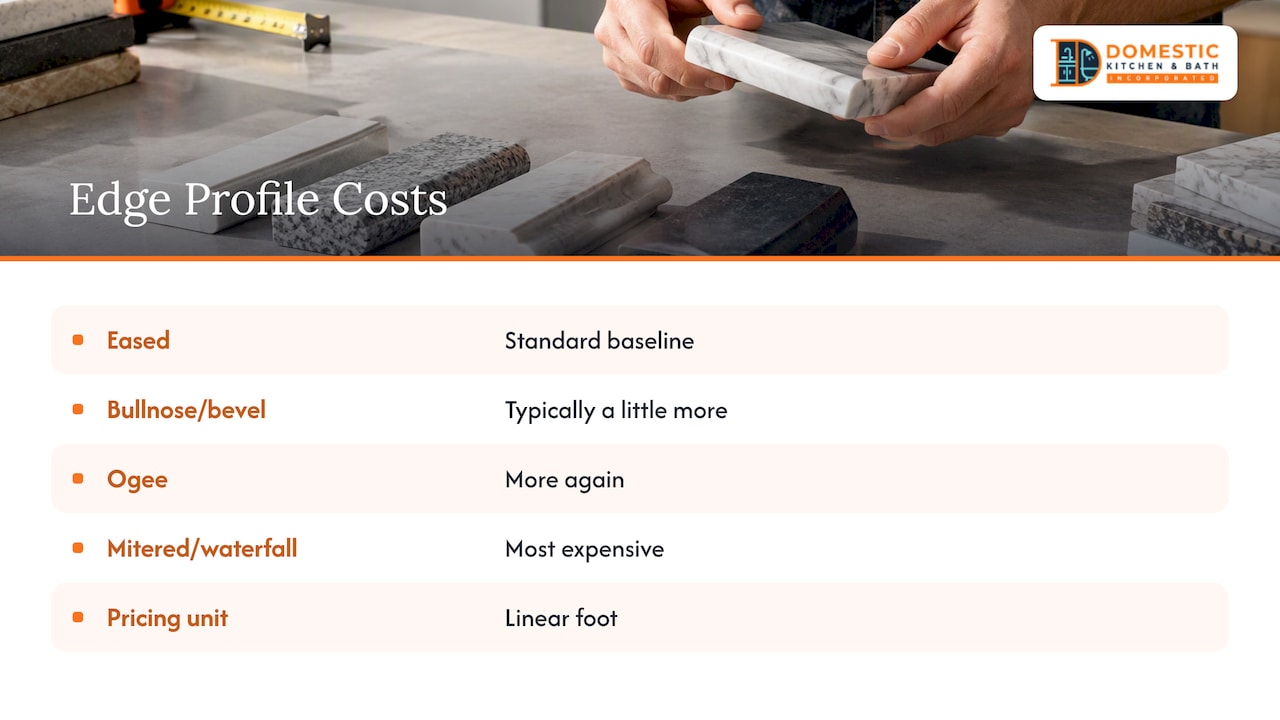
Edge pricing depends on the fabricator, the material, the thickness, your region and whether the profile needs extra material or seams. As a rule, an eased edge is the standard baseline, a bullnose or bevel typically costs a little more, an ogee more again, and a mitered or waterfall edge is the most expensive because of the labor and extra slab involved. Fabricators generally price edges by the linear foot.
We will not quote a per-foot figure here, because the range between fabricators is wide and a number from a blog is not a quote. The best step is to ask for the profile priced as a line item, so you can compare an eased edge with the upgrade you are considering. For a typical 10-foot run of counter plus a 6-foot island, a small difference per foot adds up, so ask before you sign.
How to choose your edge: a simple method
- Start with your cabinets. Flat-panel doors point to eased, straight or bevel. Raised-panel or ornate doors point to bullnose, half bullnose or ogee.
- Think about who uses the kitchen. Young children or a crowded island favor rounded edges. Serious cooks favor easy-to-clean edges.
- Match the material. Confirm with the manufacturer or installer that the profile suits your stone or quartz. Southern Living advises exactly that.
- Check the thickness. A thin slab can look thicker with a miter, but it costs more.
- Look at a physical sample. Photos flatten the shadow lines. Hold the real edge in your hand and run a cloth over it.
- Choose the edge that will outlast the trend. An eased or half bullnose edge rarely looks wrong, even a decade later.
Our perspective: what we tell Sarasota homeowners
We have remodeled kitchens, bathrooms and outdoor kitchens in Sarasota for more than 25 years, and edge profiles come up on nearly every job. Our advice is usually the same: choose the edge last, but not as an afterthought.
Most clients who arrive wanting something dramatic leave with an eased or lightly beveled edge, and they are happy with it a year later. Dramatic profiles earn their cost on a single focal point, such as an island, and they work best when the rest of the kitchen stays calm. We also lean toward softer corners in family homes, because the island is where everything happens.
For outdoor kitchens, think about use as well as looks: Florida sun, salt air, humidity and heavy entertaining are hard on fussy details. Our outdoor kitchen countertop guide covers the material side of that decision. Whatever you choose, we show you the real edge sample and the line-item price during design, so there are no surprises later.
— Mark
Planning a kitchen remodel? Start with the whole picture
An edge profile is one of dozens of choices in a remodel, and it works best when it is designed together with cabinets, layout, lighting and plumbing. We design in 3D so you can see the counters, edges and cabinets together before anything is built. Our published range for kitchen remodeling is $25,000 to $45,000, and for outdoor kitchens it is $20,000 to $50,000. If you are in Sarasota or the surrounding area, we can walk you through edge samples at your free design conversation, and you can see what we are offering on our current offers page.
FAQ
What is the most popular countertop edge profile?
The eased edge is the most common choice. It has a clean, slightly softened square shape, it is easy to wipe, and it fits both modern and transitional kitchens. It is also typically the standard, no-upcharge baseline at fabricators.
Is a bullnose edge outdated?
It is tied to traditional design, so it can look dated beside flat-panel cabinets in a minimalist kitchen. In a traditional or family kitchen it still works well, and its rounded shape is forgiving. A half bullnose or a generous eased edge is a softer, less dated alternative.
What countertop edge is easiest to clean?
Eased and straight edges are the easiest because they have no grooves and can be wiped in one pass. Ogee and other carved profiles are the hardest because debris collects in the curves. Bullnose is easy to wipe, but crumbs are harder to sweep off.
Does the mitered edge cost more than an eased edge?
Yes, usually. A mitered edge joins two pieces at a 45-degree angle, which takes more labor and material, and it commonly carries a significant premium. Ask your fabricator to price both as separate line items so you can see the exact difference for your layout.
Can I use any edge profile on quartz?
Not always. Manufacturers offer many profiles, but availability varies by brand, market and slab thickness. Confirm the profile and any price difference with your fabricator before you choose.
Sources
- Cambria: Quartz Countertop Thicknesses and Edge Profiles
- Caesarstone: Countertop Edges, Different Types for Your Kitchen Design
- Southern Living: 8 Countertop Edge Styles in Your Remodel
- House Digest: The Drawbacks to Choosing Bullnose Edges for Your Countertops
- Lilyann Cabinets: Countertop Edge Profiles
- Stonify: Countertop edge profiles, types, costs and how to choose one
- Slabwise: Every countertop edge profile explained