
Large format tile works well in most bathrooms. It gives you fewer grout lines, a cleaner look and a room that reads as larger. It also asks more of the installer than small tile does: the walls and floor have to be flat, the layout has to be planned before the first tile is set, and a shower floor needs a drain designed around the tile. Get those three things right and the result is a bathroom that looks calm and is easy to clean.
This guide covers what counts as “large,” where it works, where it causes trouble (especially in showers), and what to ask before you sign a contract.
TL;DR
- Large format tile means fewer grout lines, which makes a bathroom look bigger and takes less scrubbing. It also works in small bathrooms if you plan the layout and keep the color light.
- Shower walls are an easy fit for big tile. Shower floors are harder, because the slope to the drain can force smaller tile or a linear drain.
- The surface underneath matters as much as the tile. Flatness, mortar coverage and movement joints decide whether the job lasts.
- Hire an installer who has set large tile before. Handling, cuts and lippage (uneven tile edges) are where inexperienced crews run into trouble.
- A full bathroom remodel with us in Sarasota ranges from $15,000 to $45,000, depending on scope.
Table of Contents
- What counts as large format tile
- Are large tiles a good idea for a bathroom?
- Big tile in a small bathroom
- Large format tile in the shower
- What the installation requires
- Styles, finishes and layouts that work
- Is large format tile still in style?
- Our perspective
- Planning a large format bathroom with us
- FAQ
- Sources
What counts as large format tile
There is no single definition, and that confuses shoppers. One design source defines large format as any tile with at least one edge of 15 inches or longer. Another puts the line lower, saying large-format tile is any tile with an edge longer than 12 inches, and one major manufacturer calls 12 by 24 inches the new baseline. The same manufacturer lists 20×24, 24×24 and 24×48 inches as the large sizes.
At the far end are tile panels and slabs. The ANSI A137.3 standard, as quoted by the Ceramic Tile Education Foundation, separates ordinary tile from panels at about 11 square feet (1 square meter). Panels are thin gauged porcelain and need specialized installers. Most homeowners are choosing something smaller.
For bathrooms, the sizes you will see most are:
| Size | Typical use in a bathroom |
|---|---|
| 12×24 in | Shower walls, floors, tub surrounds. The common starting point. |
| 24×24 in | Floors and feature walls. Fewer cuts in square rooms. |
| 24×48 in | Shower walls, full-height walls, larger floors. |
If you searched for 24×48 tile for a bathroom, it is a good wall tile. It needs a wall that is flat and a crew that can carry and set it without cracking it. It is rarely the right choice for a shower floor.
Are large tiles a good idea for a bathroom?
Usually yes. Large-format tiles create a seamless look with fewer grout lines, which means less maintenance and a room that appears larger. Grout is the part of a tiled bathroom that stains, darkens and needs sealing, so every joint you remove is a bit less upkeep.
What you gain
- A continuous, uncluttered surface that looks more modern.
- Less grout to clean, which matters in a humid climate like ours.
- A broad choice of looks in porcelain, including stone, cement and marble patterns.
What you give up
The downsides are practical, not cosmetic. Bob Vila’s overview lists heavier handling, more demanding installation, sensitivity to uneven surfaces, possible breakage or lippage, and potentially more waste or labor cost. None of those is a reason to avoid large tile. They are reasons to budget for good prep and an experienced installer rather than the lowest bid.
If you are comparing quotes, a lower price for large tile often means less surface preparation. That is the line item that gets cut first and regretted later.
Big tile in a small bathroom
It feels backwards, but big tile suits small bathrooms. Large tiles create a continuous surface with fewer grout lines, and that is what makes a small room look more open. The same guidance stresses careful layout planning, light colors and grout matched to the tile. Designers quoted by Bob Vila say large tile can make a small bathroom feel bigger, especially in a light, soft neutral.
For a small bathroom, we would plan these details first:
- Match the grout to the tile. Contrasting grout draws a grid across the wall. Matching grout lets the tile read as one surface.
- Run the same tile up the wall and across the floor where the plan allows. Fewer material changes means fewer visual breaks.
- Choose light, soft colors. Dark large tile can still look good, but it gives less of the expanding effect.
- Position the cuts. In a 5-by-8-foot bathroom, a thin sliver of tile along one wall looks like a mistake. We lay out the room on paper so cuts fall at the tub, the vanity or the corners.
- Check the shower pan. Bob Vila notes large tiles are a poor fit for small, steeply sloped or irregular shower pans. In a compact bathroom, that is usually the one place to use something smaller.
For more ideas on compact layouts, see our small bathroom remodel ideas.
Large format tile in the shower
The shower is where large tile either looks excellent or causes problems. Treat the walls and the floor as separate decisions.
Shower walls
Walls are straightforward. Shower walls can take large tiles with fewer, smaller grout joints. A 12×24 or 24×48 tile running floor to ceiling gives the clean, spa-like look many couples ask for. Fewer joints also means fewer places for water to find its way into grout.
What to plan:
- Niche placement. Set the niche so tile cuts land cleanly around it. Aligning it with tile edges looks deliberate.
- Orientation. Vertical layouts make a ceiling look taller. Horizontal ones widen a narrow shower.
- Waterproofing. Large tile does not change the need for a proper waterproofing system behind it. The tile is the finish, not the barrier.
- Slip resistance and rating. Choose tile classified for the actual wet use and ask the supplier for the specification.
Shower floors
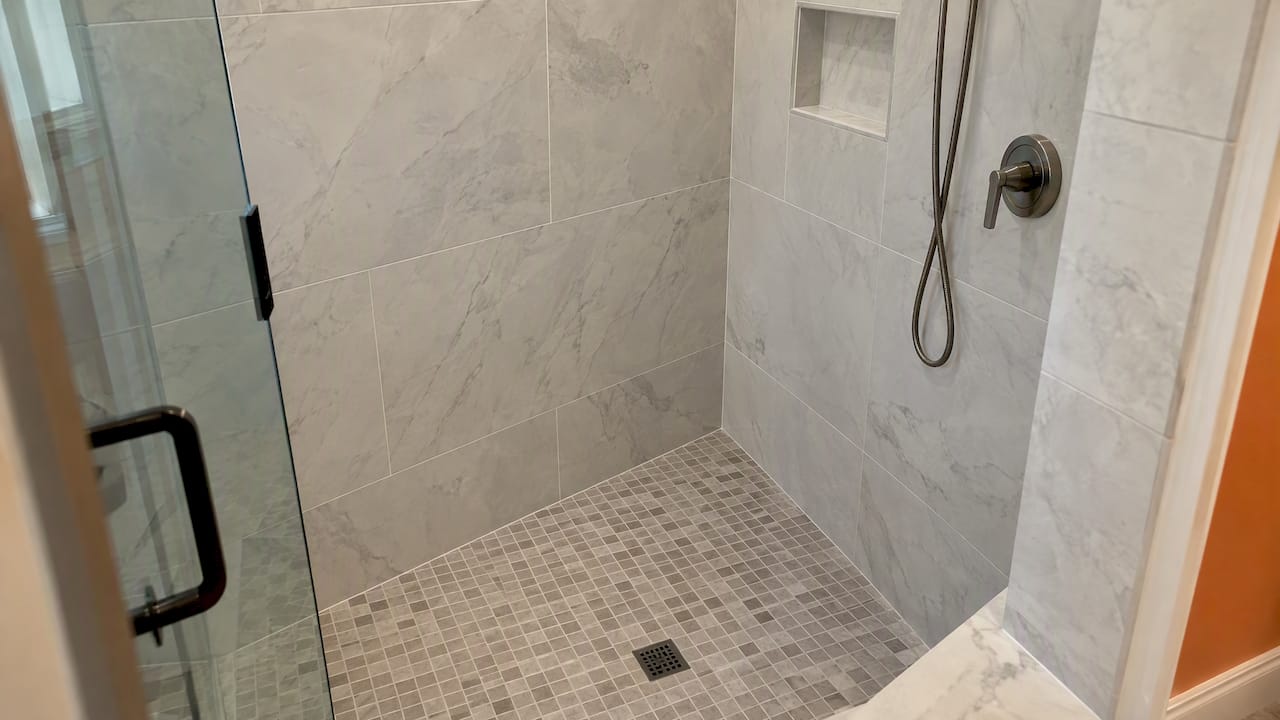
Floors are trickier because water has to run to the drain. On a floor with a center drain, the surface slopes from several directions, and a big flat tile does not bend. One planning guide notes that a center drain may require multiple slopes, and suggests three ways around it: smaller mosaic tile, a linear drain with a single-plane slope, or professionally fabricated cuts.
In practice:
| Option | Best for | Trade-off |
|---|---|---|
| Small mosaic on the floor, large tile on walls | Most showers, including small ones | More grout on the floor, though mosaic gives good grip |
| Linear drain with a single slope | Walk-in showers where you want one large tile continuing from wall to floor | Needs a compatible drain and pan system planned from the start |
| Large tile with custom-cut slopes | Large custom showers | Skilled labor and more waste |
Linear drain systems and matching pre-sloped shower trays exist for this purpose. Schluter’s KERDI-LINE drain is one example of a system that supports a single-plane slope suited to large tile. The drain type has to be chosen before demolition ends, not after the tile arrives.
Small tile on the floor does have a real advantage. It provides grip and accommodates the slope needed for drainage. Many of the best showers combine a large tile on the walls with a small tile on the floor in the same color family.
What the installation requires
Most large-tile failures start before the tile goes up. These are the checks that matter.
A flat surface
Large tile does not follow a wavy wall or floor the way small tile does. Guidance for large tile calls for a substrate that varies by no more than 1/8 inch in 10 feet and 1/16 inch in 24 inches. Improper preparation can lead to lippage, cracking or tile failure. Lippage means one tile edge sits higher than its neighbor, and you will feel it with bare feet.
The Ceramic Tile Education Foundation has a guide to checking whether a floor or wall is flat enough for large tile. Older Florida homes often need wall flattening or floor leveling before tile can go on, and that cost should appear in the quote.
Full mortar coverage
The back of a big tile needs full contact with mortar. Tile-industry standards call for at least 95% coverage in wet areas such as showers and 80% in dry areas. Ask your contractor how they check it, for example by lifting a tile during the job and looking at the back.
Movement joints
Tiled surfaces move with temperature and structure. Soft joints must be kept at the perimeters and throughout large tiled expanses. Hard grout in a corner is a common cause of cracks. These joints use flexible sealant instead of grout.
Layout and cuts
Before mortar is mixed, the crew should dry-lay the plan: where full tiles start, where cuts land and where the niche, valve and drain sit. Large tile has more waste when cuts are poorly planned, and a mistake costs more per tile.
The installer
This is the question that matters most. It is widely recommended that experienced professionals install large-format tile because of the demands of substrate prep, handling and mortar application. Ask any contractor:
- How many large-format bathrooms have you done?
- How do you check flatness, and what do you do when a wall fails?
- What drain and slope will you use in the shower?
- Where will movement joints go?
- Who is on site daily, and who is licensed and insured?
Vague answers are a sign to keep looking.
Styles, finishes and layouts that work
Most large-format bathroom floor tile is porcelain, and cement and stone looks are especially popular because they give the appearance of a single slab. Porcelain is dense, handles water well and comes in many finishes.
Practical guidelines:
- Stone and marble looks give a luxury feel without the sealing and etching concerns of natural stone.
- Cement looks suit modern bathrooms and hide water spots better than glossy tile.
- Matte or textured finishes on the floor give more grip than polished tile. Save polished tile for walls.
- Soft neutrals, warm grays and delicate stone-look whites are what experts suggest, and they advise avoiding busy patterns.
- Vertical stacks on a feature wall emphasize height. A running bond layout is possible, but with long tiles it raises lippage risk, so ask your installer about it.
Is large format tile still in style?
Yes. Large-format tile has grown in popularity over recent years and is widely described as trendy. The safer way to keep a bathroom looking current is to choose the tile for its quiet color and scale, not for a pattern. A soft neutral porcelain in a large size will look right for many years. Your faucets, lighting and accessories are easier to change later than the tile behind a shower.
Our perspective
We have spent more than 25 years remodeling kitchens and bathrooms in Sarasota, with over 1,000 projects completed. Large tile comes up in almost every bathroom consultation, and our advice is consistent.
The tile is the easy part. The prep, the plan for the drain and the way the surface is flattened decide the outcome. Florida adds its own conditions: humidity, a lot of water exposure and local permitting requirements. We plan with those in mind, which is why we talk through waterproofing, ventilation and slope before we talk about color.
For most homeowners, our recommendation is large tile on the walls and a considered solution on the shower floor, either a mosaic or a linear drain. We would rather explain a limit than sell you a design that causes problems after it is finished. If your wall is wavy, we will tell you and price the fix openly.
— Mark
Planning a large format bathroom with us
If you want a large tile bathroom designed and built as one project, our bathroom remodeling service covers design, 3D planning, demolition, plumbing, electrical, waterproofing, ventilation, tile and project management under one roof. Our published range for bathroom remodeling is $15,000 to $45,000, depending on size and scope. We are licensed and insured, we offer a satisfaction guarantee, and we have an average customer rating of 4.9 out of 5.
To see how the work is organized or ask about a project, start at Domestic Kitchen & Bath or check current offers.
FAQ
What are the disadvantages of large format tiles?
They are heavier and harder to handle, less forgiving of uneven walls and floors, and more likely to show lippage or break during installation. They can also add waste and labor cost. Most of these problems are avoided with proper surface prep and an experienced installer.
Can you use large format tile on a shower floor?
Sometimes. A center drain usually needs multiple slopes, which is hard with big tile. The usual solutions are a mosaic floor, a linear drain with a single slope, or custom-cut tiles. In a small shower, mosaic is often the most practical choice.
Is 24×48 tile too big for a small bathroom?
Not on the walls. A 24×48 tile with matching grout gives a small bathroom a clean, open look, provided the layout avoids thin cuts. On the floor, 24×48 can be awkward in a very small room, and 12×24 or 24×24 usually fits better.
Do large tiles need special grout or joints?
They need narrower joints, grout matched to the tile for a seamless look, and flexible movement joints at perimeters and across big areas. Your installer should mark where these go in the plan before work starts.
Should I install large format tile myself?
We advise against it for a bathroom you plan to live in. Substrate prep, mortar coverage and handling are demanding, and it is widely recommended that experienced professionals do the work.
Sources
- Large Format Tile: Sizes, Install Rules and Cost
- Is Your Floor or Wall Flat Enough for Large Format Tile?
- Large Format Tile Takes the Lead
- Large-Format Tile Could Be the Best Thing You Do in Your Bathroom
- Large Format Tile Installation Planning Guide
- Schluter KERDI-LINE Shower Drains
- Getting the Coverage You Need Under Large Wall Tile
- Understanding Bathroom Tile Options, Fine Homebuilding
- Slope Guidelines for Large Format Tile Shower Floors
- How to Choose Bathroom Floor Tile